You’ve earned your license.
You’ve chosen a radio.
You’ve programmed some frequencies, connected an antenna, and successfully managed to avoid letting the smoke out of anything.
Now there’s just one little problem.
You actually have to press the button and talk to somebody.
For some new amateur radio operators, that can be more intimidating than taking the license exam.
What are you supposed to say?
What if you use the wrong terminology?
What if you forget somebody’s callsign?
What if you make a mistake?
Relax.
Amateur radio isn’t a performance, and nobody handed the rest of us a perfect script when we started.
The best way to become comfortable operating a radio is to operate a radio.
Let’s get on the air.
Before You Press the Button
The first thing to do is simple:
Listen.
Listen to how people are using the frequency.
Listen to how they identify.
Listen to the rhythm of the conversation.
Listen for whether a repeater or frequency is already in use.
If you’re trying something unfamiliar, listening for a few minutes can answer a surprising number of questions.
This becomes even more important when you move between different kinds of amateur radio operation.
A casual repeater conversation sounds different from a directed net.
An HF ragchew sounds different from a contest.
A busy Parks on the Air activation sounds different from someone calling CQ looking for a casual conversation.
Good operators learn to recognize what’s happening before jumping into it.
Know Your Callsign
You’re going to use your callsign a lot.
Fortunately, the FCC was kind enough not to require you to invent a new one every time you transmit.
Learn to say it clearly and naturally.
If your callsign is new enough that you still have to think about it, that’s perfectly normal.
Practice saying it aloud.
You’ll soon reach the point where saying your callsign requires about as much thought as saying your name.
You may also hear operators use standard phonetics to make callsigns easier to understand when signals are weak or conditions are noisy.
They’re useful.
Learn them.
But don’t let worrying about perfect phonetics keep you from making your first contact.
Your First Contact
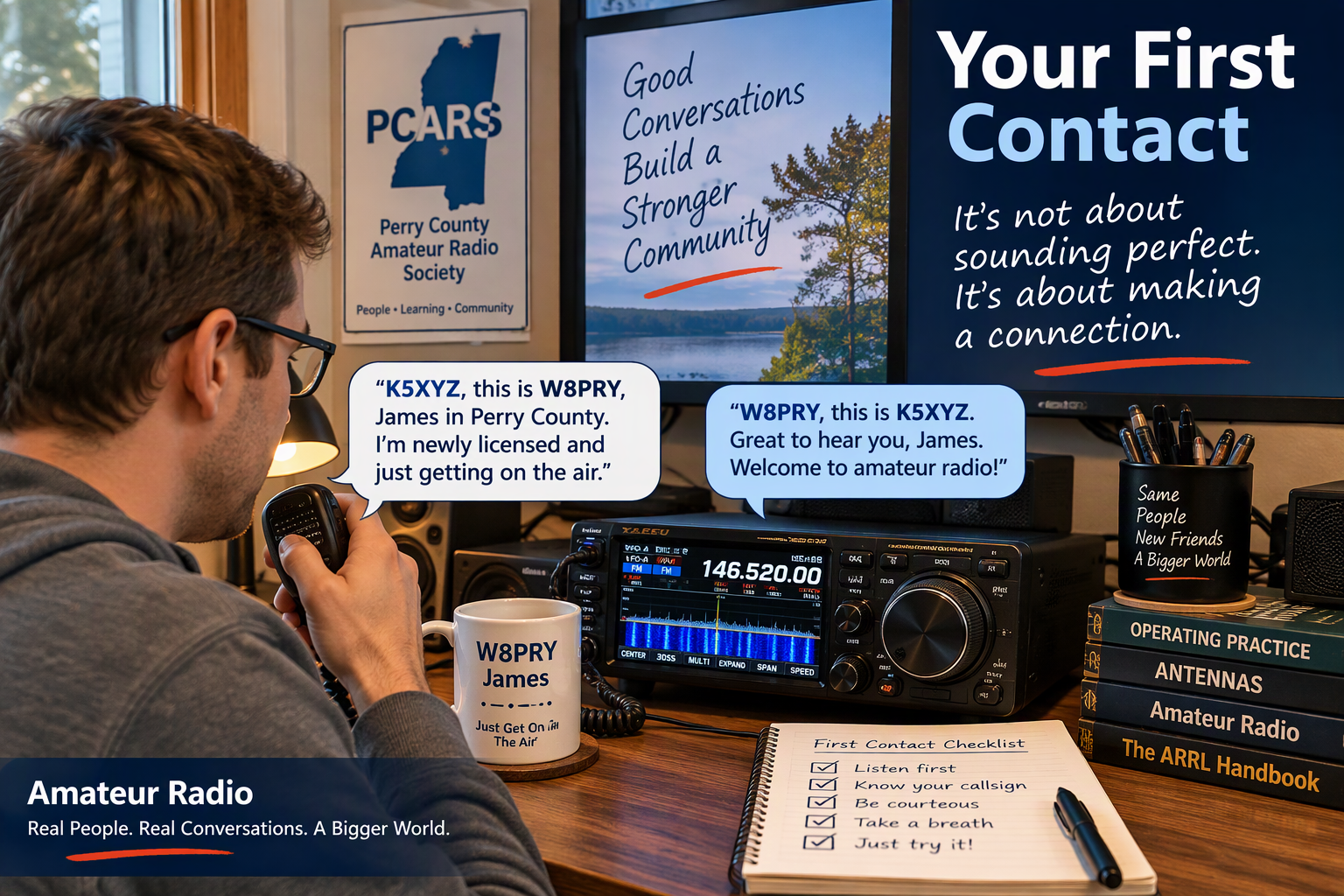
Your first contact does not need to be elaborate.
If you’re using a local repeater, you may hear operators announcing that they’re listening.
You can do the same.
Identify with your callsign and indicate that you’re monitoring or listening.
If somebody answers, congratulations.
You’re having a contact.
You don’t suddenly need to transform into a nineteenth-century telegraph operator.
Talk normally.
Exchange callsigns.
Tell the other operator your name if you want.
Mention that you’re newly licensed or that this is one of your first contacts.
Ask a question.
Talk about the radio you’re using.
Talk about your antenna.
Ask about their station.
The important part is to communicate clearly and identify as required.
Everything else gets easier with experience.
Using a Repeater
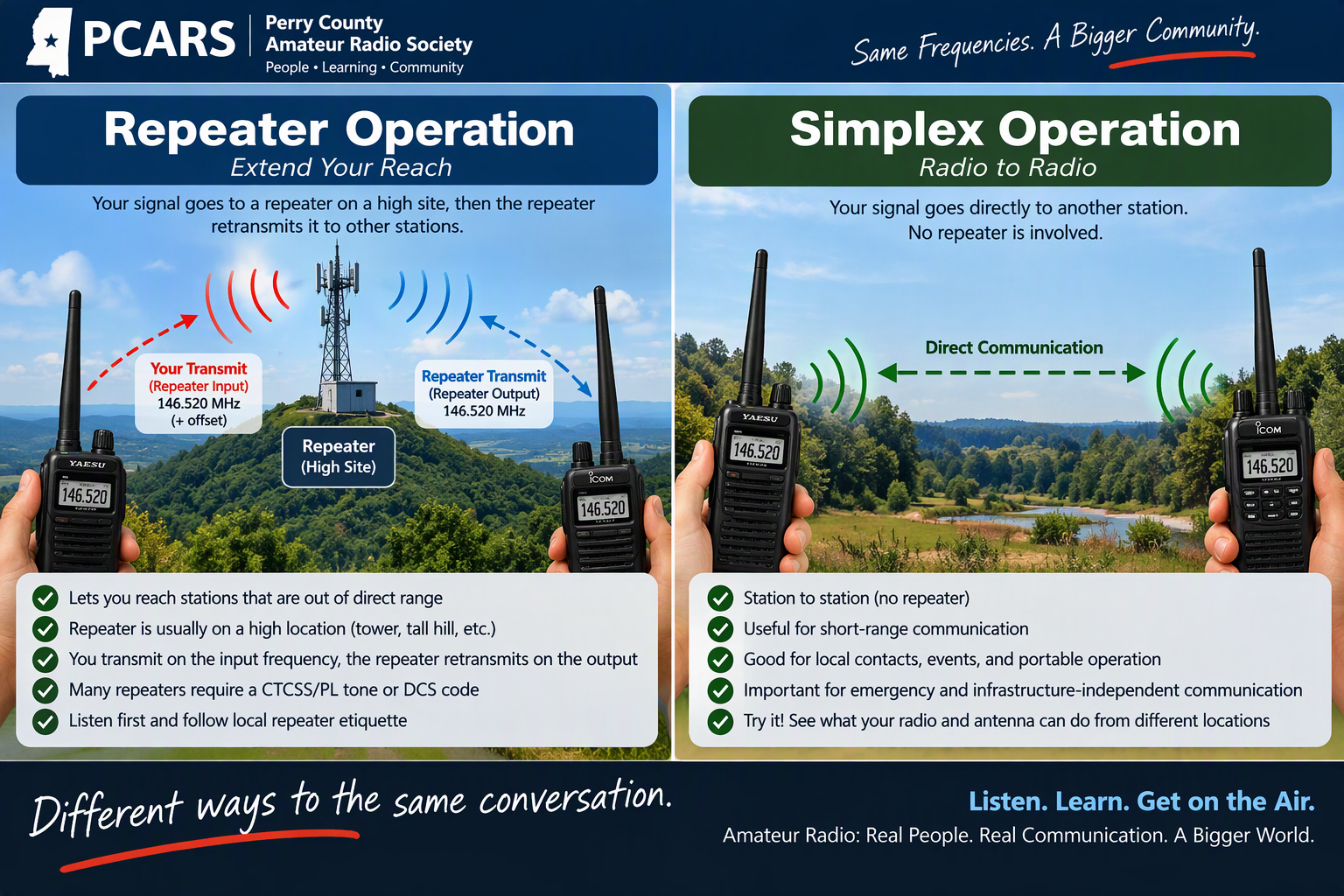
A repeater receives a signal on one frequency and retransmits it on another.
That allows stations that might not be able to communicate directly to communicate through a station located at a favorable site.
Your radio therefore normally listens to the repeater’s output frequency and transmits on its input frequency.
The difference between those frequencies is the offset.
Many repeaters also require a tone or digital code before the repeater will respond to your transmission.
Depending on the system, you may encounter terms such as:
- CTCSS
- PL tone
- DCS
- DPL
Your radio needs to be configured appropriately for the repeater you’re trying to use.
Fortunately, once the repeater is programmed correctly, normal operation is pretty straightforward.
Listen Before Transmitting
Before transmitting, listen.
A quiet moment doesn’t necessarily mean the repeater is unused.
You may have tuned in during a pause between two operators.
Listen long enough to get a reasonable idea of what’s happening.
If the repeater seems quiet, identify and make your call.
Leave a Little Space
When you’re talking through a repeater, don’t immediately key the transmitter the instant the other station stops.
Leave a brief pause.
That gives another station an opportunity to enter the conversation and can be particularly useful if someone has priority or emergency traffic.
It also makes a conversation involving several operators much easier to manage.
Don’t Kerchunk the Repeater
You’ve programmed the repeater and want to know whether you can reach it.
So you briefly press PTT without identifying just to hear whether the repeater comes back.
That’s often called kerchunking.
Don’t make a habit of it.
If you want to test whether you’re reaching the repeater, identify yourself and make an actual test transmission.
That’s both more useful and better operating practice.
Simplex
Not every VHF or UHF contact needs a repeater.
Simplex means your station communicates directly with another station rather than passing through a repeater.
Radio to radio.
That’s one of the most fundamental forms of radio communication.
Simplex is useful for local contacts, events, portable operation, and situations where stations are close enough that using a repeater isn’t necessary.
It’s also worth practicing if emergency communications or preparedness interests you.
A repeater is infrastructure.
It’s useful infrastructure, but it’s still infrastructure.
Knowing what your station can accomplish without depending on a repeater gives you a much better understanding of your actual communications capability.
Try simplex.
Change locations.
Try different antennas.
Compare handheld and mobile radios.
Learn what works.
That’s amateur radio.
How Do I Join a Conversation?
This is another situation where listening tells you a great deal.
If several operators are already talking on a repeater, wait for a natural break.
Depending on local practice and the type of conversation, you may be able to identify with your callsign during the pause to indicate that you’d like to join.
Then wait for one of the existing operators to acknowledge you.
Don’t be surprised if it feels awkward the first few times.
Timing is something you learn through experience.
If you accidentally double with someone, stop transmitting and try again when the frequency is clear.
It happens, even to experienced operators.
Most operators will recognize what happened. They may acknowledge the double, finish what they were saying to the other station, and then invite you into the conversation.
So don’t assume that a double means you did something terribly wrong or that you should disappear from the frequency.
Pause, listen, and give everyone a moment to sort it out.
There’s a pretty good chance somebody will come back with your callsign and invite you in.
What Do I Say?
Whatever you need to communicate.
Really.
New operators sometimes expect amateur radio conversations to require a special vocabulary.
There are operating terms worth learning, but normal voice contacts generally don’t require you to speak in code.
You can say:
“This is [your callsign]. I’m newly licensed and just getting on the air.”
That’s enough to start a conversation.
If you’re calling a particular operator:
"[their callsign], this is [your callsign]."
If someone calls you:
"[their callsign], this is [your callsign]. Go ahead."
Clear communication beats impressive-sounding jargon.
Every time.
You Don’t Need Police or Military Radio Language
Amateur radio has its own conventions, but it isn’t public-safety dispatch and it isn’t military radio.
If your background includes another radio service, some operating habits may naturally follow you.
That’s fine.
But you don’t need to manufacture a radio voice or fill every transmission with procedural language.
Use plain language when plain language works.
Say what you mean.
Say it clearly.
Then let somebody else talk.
That last part can occasionally be the advanced course.
Nets
A net is an organized group of amateur radio operators meeting on a particular frequency or system for a particular purpose.
Some nets are primarily social.
Others involve technical topics, traffic handling, public service, weather, emergency communications, or training.
Many nets are directed nets, meaning a Net Control Station manages the flow of communications.
If you’re new to a net, the easiest thing to do is listen.
The Net Control Station will normally explain how check-ins are being handled.
Listen to several other stations check in.
Then follow the same basic pattern.
You may be asked for information such as:
- Your callsign
- Your name
- Your location
- Whether you have traffic
- Whether you have comments or announcements
The exact procedure depends on the net.
That’s why listening first works better than memorizing one universal check-in script.
There isn’t one.
Don’t Be Afraid to Check Into a Net
It’s easy to listen to ten experienced operators checking in smoothly and convince yourself that you should wait until you sound like them.
Don’t.
They became comfortable checking into nets by checking into nets.
If you stumble over your callsign, forget what you intended to say, or need the Net Control Station to ask you to repeat something, the world will continue turning.
Check in.
Listen.
Learn.
Come back next week.
It gets easier.
HF Is a Little Different
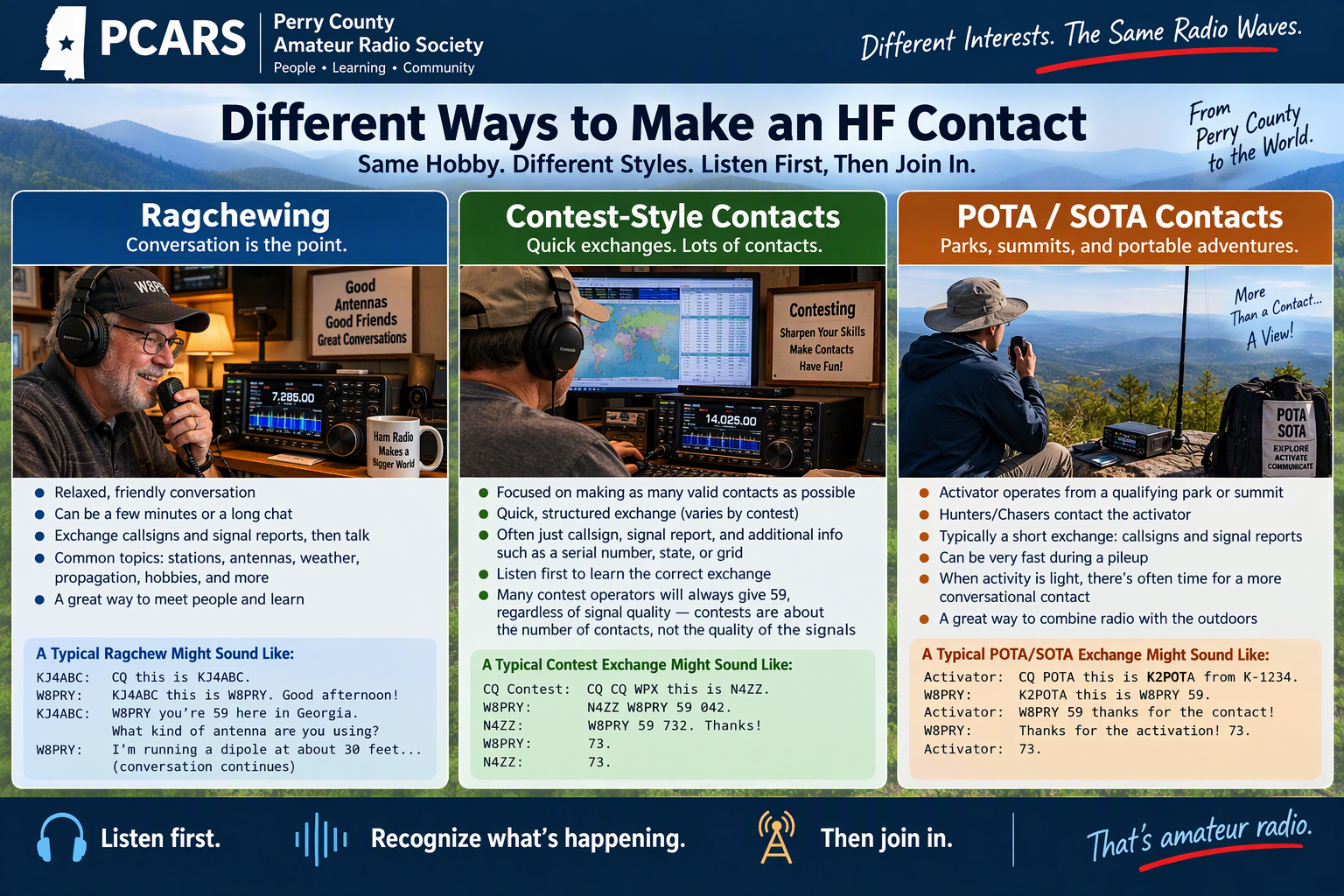
When you move onto the HF bands, you’ll encounter different operating styles.
You may hear stations calling CQ, which is a general call inviting other amateur stations to respond.
You may also hear a station calling “CQ DX.”
DX generally means a distant station, and when an operator calls CQ DX, they’re telling you that they’re specifically looking for long-distance contacts, often stations in another country or on another continent.
Maybe the band just opened toward another continent. Maybe the operator is trying to work a new country. Maybe they simply want some long-distance contacts.
You may be able to hear them perfectly well from a few states away, but that doesn’t necessarily mean they’re looking for you.
While there’s generally nothing preventing you from answering, good operating practice is to respect what the other operator is asking for.
If they’re calling CQ DX and you’re clearly not the kind of distant station they’re trying to work, let the call go and move along.
There will be another frequency and another contact.
You may hear long conversations between two stations.
You may hear a frequency filled with stations exchanging information almost as quickly as they can identify.
You may hear an operator activating a park or summit with a pileup of stations trying to make contact.
These aren’t contradictory ways to use amateur radio.
They’re different kinds of operating.
The trick is recognizing which one you’re hearing.
Ragchewing
A ragchew is simply a longer, conversational contact.
The contact might begin with callsigns, names, locations, and signal reports, then continue into a conversation.
Operators may talk about:
- Their stations
- Antennas
- Radios
- The weather
- Propagation
- Where they live
- Projects they’re working on
- Other hobbies
- Almost anything else appropriate for the frequency
Some contacts last only a few minutes.
Others become lengthy conversations.
If both operators are enjoying the conversation and nobody has somewhere else to be, there isn’t any requirement to turn every contact into an efficiency exercise.
Sometimes the conversation is the point.
Contest-Style Contacts
Contesting is very different.
In a contest, operators are trying to make valid contacts according to the rules of that particular event.
Contacts are therefore often brief.
The required exchange differs from one contest to another.
It might include a signal report, location, serial number, operating category, or some other information specified by the contest rules.
Don’t assume you know the exchange because you heard a different contest last month.
Listen first.
After hearing several contacts, you’ll often begin recognizing the pattern.
If you decide to participate, know what information you’re expected to exchange before calling.
A contest operator trying to work a pileup probably isn’t looking for a leisurely discussion of your antenna project.
That’s not rudeness.
That’s the operating activity taking place at that moment.
POTA and SOTA Contacts
Parks on the Air (POTA) and Summits on the Air (SOTA) introduce another style of operating.
An operator who sets up and operates from the qualifying location is generally the activator.
Stations trying to contact that operator are commonly called hunters in POTA and chasers in SOTA.
These contacts can be relaxed when activity is light.
They can also become very short when many stations are trying to contact the activator.
A typical contact may involve little more than correctly exchanging callsigns, signal reports, and a brief acknowledgment.
The goal isn’t necessarily to have a long conversation.
The activator may be trying to work many stations while dealing with limited time, battery power, changing weather, propagation, or everything else involved with operating away from a permanent station.
If the activator is working stations quickly, follow that rhythm.
Call.
Make the contact.
Exchange the necessary information.
Say thanks.
Then let the next station have a turn.
When activity is light, there may be plenty of opportunity for a more conversational contact.
Again, listening tells you what kind of operating is taking place.
Listen to the Operator You’re Calling
This may be one of the most useful operating lessons you can learn.
Adapt to the kind of contact the other station is making.
If someone calls CQ looking for a casual contact, replying with nothing but a rapid signal report and disappearing isn’t necessarily what that operator had in mind.
If a contest station is working contacts every few seconds, don’t begin a ten-minute discussion about the coax you installed yesterday.
If a POTA or SOTA activator has a pileup waiting, help keep things moving.
Listen.
Understand what’s happening.
Then participate appropriately.
You don’t need a rule book for every conversation when you’re paying attention to the conversation itself.
Calling CQ
When you’re calling CQ on a quiet frequency, remember that the other operator has to find you first.
Someone may be tuning across several hundred kilohertz of band looking for activity. They hear part of your CQ, stop tuning, move back toward your signal, tune you in properly, and then listen for your callsign.
Give them enough time to do that.
Make your CQ calls long enough, or frequent enough, that someone moving across the band has a reasonable chance of finding you.
One quick CQ followed by three minutes of silence is a remarkably effective way of remaining undiscovered.
If nobody answers, call again.
Propagation may be poor. The band may be quiet. Your signal may not be reaching where you hoped. Or the operator who heard the last half of your callsign may simply be waiting for you to say it again.
Give people a chance to find you.
If You’re Operating Split, Say So
In split operation, you transmit on one frequency and listen for callers on another.
That’s perfectly useful, particularly when a station is attracting enough callers that separating the transmit and receive frequencies makes operation easier.
There’s one rather important detail:
Tell people where you’re listening.
If you’re calling on one frequency and listening somewhere else, the stations answering you need to know where to transmit.
You might hear an operator say something such as “listening up 5”, indicating that replies should be made approximately 5 kHz above the station’s transmit frequency.
If you don’t tell anybody where you’re listening, you may spend a very peaceful afternoon calling CQ and wondering why nobody answers.
They may be answering.
You’re just listening somewhere else.
Answering CQ
If you hear a station calling CQ and you’d like to make contact, listen carefully for the station’s callsign.
Make sure you copied it correctly.
When the station finishes calling and invites replies, answer with your callsign.
If conditions make your callsign difficult to copy, use the standard phonetic alphabet.
Use the correct phonetics. Don’t make up your own.
Standard phonetics exist so that both operators already know what each word represents. Inventing your own may be memorable to you, but under weak or noisy conditions it can make your callsign harder rather than easier to copy.
The ARRL Quick Reference Operating Aids includes the standard ITU phonetic alphabet along with several other useful operating references.
Learn the phonetic alphabet. Before long, you’ll use it without having to think about it.
If the calling station comes back to you, proceed with the contact.
If the station responds to somebody else, wait.
Don’t keep transmitting over the station that was acknowledged.
You’ll get another chance.
Pileups
Sometimes many stations call the same station at once.
That’s a pileup.
Your instinct may be:
LOUDER!
Resist the instinct.
Listen to how the station controlling the pileup is working callers.
The operator may ask for a specific callsign heard partially, a geographic area, or some other subset of callers.
If that doesn’t describe you, wait.
Calling when the operator is specifically asking for somebody else usually doesn’t improve your chances.
Good pileup operating involves listening at least as much as transmitting.
Possibly more.
Signal Reports
Signal reports are supposed to tell another operator something useful about the signal you’re receiving.
If a station is genuinely a 42, an honest 42 tells the operator considerably more than an automatic 59.
Then you discover contesting.
In some contests, you’ll hear 59 exchanged so consistently that you may begin to suspect every antenna on the band has suddenly become magnificent.
Don’t worry about it.
For many contest operators, the report has effectively become part of a fast, standardized exchange. If you’re answering a contest station and the operator is rapidly handing out 59 reports, follow the exchange and keep things moving.
The contest is about making valid contacts efficiently, not stopping each QSO for an antenna evaluation.
During an ordinary contact, though, give a useful report.
If you’re a 59, you’re a 59.
If you’re a 42, you’re a 42.
That’s information the other operator can actually use.
Ending a Contact
Eventually a contact needs to end.
This does not require an elaborate ceremony.
Thank the other operator for the contact.
Identify appropriately.
Say goodbye.
You’ll hear 73 used frequently in amateur radio as a friendly sign-off.
You don’t need to append every radio expression you’ve ever learned to the end of one transmission.
Something simple works just fine:
“Thanks for the contact. This is [your callsign]. 73.”
Done.
You have successfully escaped the conversation without filing any paperwork.
Good Operating Habits
Good operators develop habits that make amateur radio more pleasant for everyone.
Listen First
Yes, we’re saying it again.
There’s a reason.
Identify Clearly
Know and follow the identification requirements that apply to your operation.
Don’t make people guess who they’re talking to.
Use Phonetics When They Help
Standard phonetics are useful when signals are weak, callsigns are difficult to copy, or stations are being confused.
Use them to improve communication, not to make yourself sound official.
Leave Room for Other Stations
We’re not exactly suffering from overcrowded repeaters in Southeast Mississippi.
Unless a net is underway, you may have considerably more trouble finding somebody to talk to than finding an opening to talk.
Still, leave a little room between transmissions.
Another station may be waiting to join the conversation, make a call, or pass traffic.
During a directed net, follow the instructions of Net Control and let Net Control manage who transmits and when.
Use the Minimum Power That Reliably Does the Job
More power isn’t automatically better.
If you can communicate reliably with less, there may be no reason to use more.
Make Sure the Frequency Is Clear
Before transmitting, listen.
On HF, don’t assume that a frequency is clear simply because you don’t immediately hear anyone.
Propagation can mean that you hear one station involved in a contact but not the other, and stations may leave pauses between transmissions.
Listen for a while.
If the frequency appears clear, ask:
“Is this frequency in use?”
Pause and listen.
Ask again:
“Is this frequency in use?”
Pause and listen again.
If necessary, ask a third time:
“Is this frequency in use?”
If nobody responds after you’ve listened and asked several times, you’ve made a reasonable effort to determine that the frequency is available.
If somebody responds that the frequency is in use, acknowledge them and find another frequency.
Spending a few extra seconds checking is considerably easier than discovering you’ve planted your CQ in the middle of somebody else’s contact.
Be Courteous
You’re sharing radio spectrum with other people.
Act accordingly.
You don’t need to agree with everybody you hear.
You do need to operate responsibly.
And remember one of the fundamental truths of amateur radio:
Hams have opinions, and some will make sure that you know theirs.
You’re under no obligation to prove somebody wrong just because you disagree.
Sometimes the most sophisticated piece of equipment in the shack is the tuning knob.
Use it.
Or, to borrow an old piece of advice:
Never argue with an idiot. They’ll drag you down to their level and then beat you with experience.
Spin the dial.
Life is too short, and there are plenty of other frequencies.
Mistakes Will Happen
You will eventually:
- Forget a callsign.
- Say the wrong callsign.
- Push the wrong button.
- Transmit on the wrong memory.
- Forget what you were about to say halfway through saying it.
- Discover that your radio is still configured for whatever strange experiment you were doing yesterday.
- Call someone and completely fail to remember their name three seconds after they told you.
- Learn that a menu option you were absolutely certain did one thing actually does something else entirely.
Congratulations.
You’re a ham.
Correct the mistake.
Apologize if appropriate.
Fix what needs fixing.
Move on.
Experienced operators make mistakes too.
They’re simply more experienced at recognizing which mistake they just made.
Don’t Let the Radio Scare You
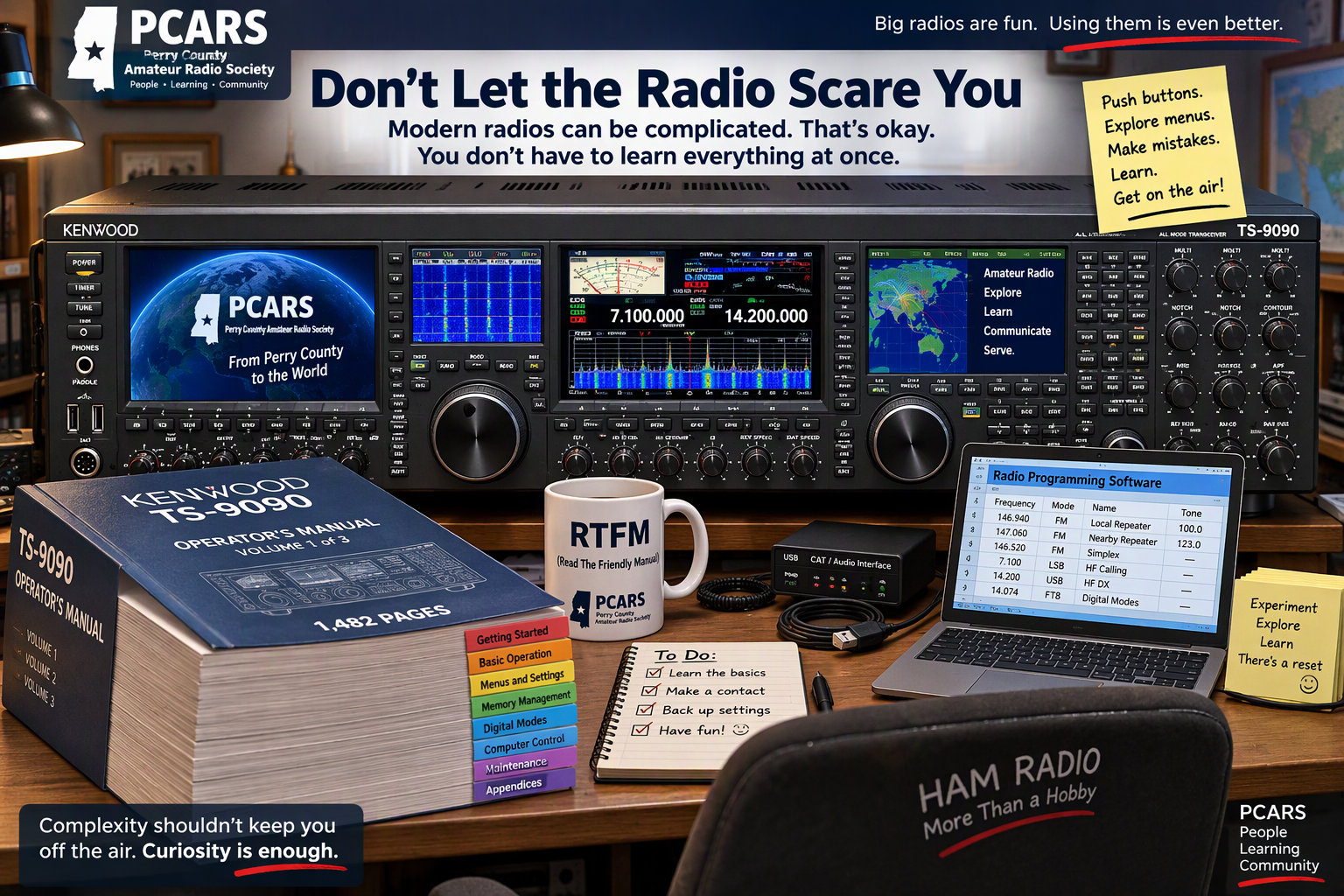
Modern amateur radios can be complicated.
Menus, memories, filters, digital modes, programmable buttons, networking features, computer interfaces, and dozens of settings can make a new radio seem like something requiring a type rating.
Don’t be afraid to experiment.
Push buttons.
Explore menus.
Change settings and learn what they actually do.
And remember:
The factory reset button or procedure is your friend.
If you manage to configure the radio into a state previously thought impossible by its engineers, you can usually get back to a known starting point.
Just know what your particular radio’s reset procedure will erase before you use it. A complete reset may also wipe out memories and other configuration you’ve spent time entering.
A backup of your settings is cheap insurance.
If your radio supports saving its configuration, get into the habit of making a backup after you’ve got everything working the way you want it.
Then when experimentation turns into “What in the world did I just do?”, you have a known-good configuration to return to instead of rebuilding everything from scratch.
Don’t forget to RTFM (Read the Friendly Manual).
Admittedly, the reset procedure may occasionally be easier to understand.
Start with what you need to make a basic contact, then learn the rest as your interests grow.
Your First Contact Will Probably Be Uneventful
This may be disappointing after all that worrying.
You’ll press PTT.
You’ll say your callsign.
Someone will answer.
You’ll talk for a little while.
You’ll identify.
The contact will end.
Nothing will catch fire.
The FCC will not dispatch helicopters because you stumbled over a phonetic.
And the experienced operator on the other end will probably remember exactly what it was like to make a first contact.
Ask for Help
If you’re unsure how to use a repeater, make a simplex contact, check into a net, call CQ, answer a POTA or SOTA activator, or do something else on the air, ask.
That’s what Elmers and amateur radio clubs are for.
PCARS is interested in helping people actually use their licenses, not merely pass examinations and collect callsigns.
If possible, operate alongside someone experienced.
Listen to what they do.
Ask why they do it.
Then take the microphone and try it yourself.
Get On the Air
At some point, reading about amateur radio stops helping.
You have to press the button.
You don’t need to know everything.
You don’t need the perfect radio.
You don’t need the perfect antenna.
And you absolutely don’t need to sound like you’ve been doing this for 40 years.
Listen.
Identify.
Be courteous.
Make mistakes.
Learn.
Make another contact.
That’s how operators become experienced operators.
Get on the air.
If you’d like some help making that first contact, contact us at info@pcars.club.